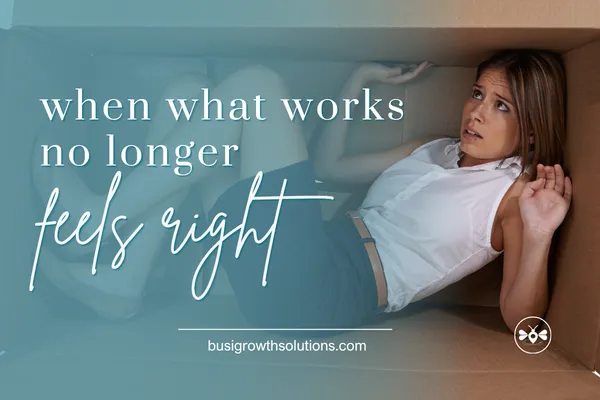
When What Works No Longer Feels Right
The Hidden Cost of Adaptation in Business: When What Works No Longer Feels Right
There’s something I’ve been noticing lately in conversations with business owners, and it’s not usually what people expect.
Most of the time, the challenge isn’t that something is broken.
Clients are still coming in. Revenue is still happening. The business is still moving forward. From the outside, everything appears to be working exactly as it should.
But underneath all of that, something feels different.
Maybe things take more energy than they used to. Maybe you're carrying more than you realize. Maybe you've adjusted so many times to keep everything moving that you've stopped noticing what those adjustments are costing you.
The truth is, you don’t always realize how much you’ve adapted to your business until you pause long enough to look at it. And when you do, you may discover that some of the things you've accepted as “just the way it is” no longer make sense for the business or life you want to create.
How Adaptation Happens Without You Realizing It
One of the most overlooked parts of entrepreneurship is how quickly we adapt.
We adjust our expectations for how long projects should take. We adjust our schedules to fit new demands. We adjust our standards for what feels realistic in the current season. We adjust our energy, our routines, and sometimes even our goals.
At first, these changes often feel temporary.
We tell ourselves we'll revisit them later. We convince ourselves we're simply getting through a busy season or navigating a challenge. The adjustment serves a purpose, so we keep moving.
But then something interesting happens.
What was temporary becomes permanent. What was once a workaround becomes the process. What was once uncomfortable starts to feel normal.
Not because we consciously chose it, but because humans are remarkably adaptable.
As business owners, adaptability is often celebrated as a strength. In many ways, it is. The ability to pivot, solve problems, and navigate uncertainty is part of what allows businesses to survive and grow.
But there’s another side to adaptation that doesn’t get talked about enough.
Sometimes we adapt to things that no longer serve us.
Why Business Can Feel Heavier Even When It's Working
One of the themes that has come up repeatedly is this quiet shift many business owners experience.
Nothing breaks. There isn't a dramatic failure. There isn't a major crisis demanding attention. Instead, things slowly start to feel heavier.
The strategies that once felt exciting now feel draining. The routines that once created momentum now feel restrictive. The way you're operating technically still works, but it requires more effort, more mental energy, and more maintenance than it used to.
Most people don't stop to examine that feeling. They assume it's part of growth. They assume it's what success requires. They assume everyone feels this way. So they keep pushing forward.
But sometimes that heaviness is trying to tell us something important. Sometimes it's not a sign that we need to work harder. Sometimes it's a sign that we've outgrown the way we're currently operating.
The Business Alignment Question Most People Aren't Asking
I had a conversation recently with a client that perfectly illustrated this. As we talked through her business, she realized something that had been sitting just beneath the surface. The way she was running her business wasn't aligned with how she wanted it to feel anymore. Nothing was objectively wrong.
She wasn't failing. She didn't need a new strategy. She had simply adapted over time.
She had adjusted to systems, expectations, and ways of operating that helped her keep things moving. But somewhere along the way, she stopped questioning whether those things still fit the version of the business she was building.
That realization is more common than most people realize. Many business owners assume they're stuck because they don't know what to do next. In reality, they often know exactly what needs to happen.
The challenge is that they've become accustomed to carrying things that no longer belong in this season of business.
Hidden Business Burnout Doesn't Always Look Like Burnout
When people think about burnout, they often picture exhaustion, overwhelm, or reaching a breaking point. But hidden business burnout can look much different.
It can look like constantly managing things that no longer energize you.
It can look like maintaining processes that feel outdated.
It can look like continuing to say yes to responsibilities you've quietly grown tired of carrying.
Because the business is still functioning, these situations rarely get addressed.
After all, if it's working, why change it? But that's the trap. Just because something works doesn't mean it's working well. And just because you've adapted to something doesn't mean it's still the right fit.
Sometimes the things creating the most friction in a business aren't obvious problems. They're simply old solutions that have outlived their usefulness.
What Have You Accepted As "The Way It Has To Be"?
This is the question I've been sitting with lately, and I think it's one worth asking yourself.
Where have you adjusted in your business without ever stopping to question it?
What have you accepted as "this is just how it has to be"?
What assumptions are you operating under that may no longer be true?
Maybe it's your schedule. Maybe it's a service you offer/product. Maybe it's the amount of availability you've created for clients. Maybe it's a marketing strategy, a pricing structure, or a responsibility you've carried for years.
Whatever it is, it's worth examining. Because sometimes the biggest breakthroughs don't come from discovering something new. Sometimes they come from questioning something old.
The Next Level Might Require Letting Go
Business growth often gets framed as adding more.
More strategies. More systems. More content. More offers. More complexity.
But some of the most meaningful growth happens when we remove something instead. The next level of your business may not require another tactic. It may require letting go of an expectation you've outgrown. It may require releasing a habit that's no longer serving you. It may require acknowledging that something which once made perfect sense no longer aligns with who you are, how you want to work, or where you're headed.
That's awareness. And awareness creates the opportunity for intentional change.
Reflection Worth Sitting With
If any of this resonates with you, I want to leave you with a simple question:
What have you adapted to in your business that you've never stopped to question?
Find a quiet place. Grab your journal. Give yourself space to answer honestly. Not from a place of fixing. Not from a place of forcing solutions. Simply from a place of noticing.
Because sometimes the thing standing between where you are and where you want to go isn't a lack of strategy, knowledge, or effort. Sometimes it's the weight of something you've been carrying for so long that you forgot it was even there. And sometimes the next level in business isn't something you add. It's something you stop tolerating.
When Business Feels Active But Not Steady
One of the challenges with adaptation is that it can be difficult to see clearly when you're in the middle of it. What feels normal to you today may actually be creating pressure, inconsistency, or unnecessary complexity behind the scenes.
If your business feels active but not steady, this is exactly what we look at inside the Reliable Revenue Audit.
Together, we identify where things may be relying too heavily on you, where consistency is breaking down, and what's creating pressure underneath the surface. More importantly, we uncover what needs to shift so your business feels more supported, sustainable, and aligned with how you actually want to operate.
Because often, the goal isn't to do more. It's to stop carrying things that no longer belong.
If you're ready to take a closer look at what's really happening beneath the surface of your business, grab a free 30-minute call for a ‘Reliable Revenue Audit.’