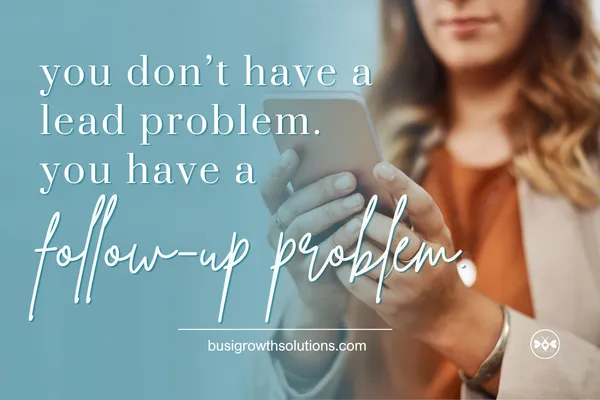
You Don’t Have a Lead Problem. You Have a Follow-Up Problem.
Before you spend more time finding new people, take a closer look at the ones who have already shown interest.
When business slows down, one of the first things many business owners think is that they need more leads.
It makes sense. If there aren’t enough new clients coming through the door, it seems logical that the answer must be to get more people into the business. More people are seeing your posts. More people are visiting your website. More conversations. More inquiries. More names on your email list.
And there are certainly times when a business does need to increase its visibility and bring more potential clients into the pipeline.
After years of working with business owners, I’ve learned that the number of people entering your world doesn’t always tell the whole story. Sometimes there is already interest there. The problem is that the business owner isn’t doing anything with it.
That can be a difficult thing to see because it's much easier to measure how many people you reached than to look closely at what happened after someone showed interest. We can see the number of views on a post. We can see how many people downloaded a free resource. We can see how many people attended an event or joined our email list.
What we don’t always pay attention to is what happened next. And that “next” can have a significant impact on your revenue.
Interest Doesn’t Always Arrive as a Ready-to-Buy Client
One reason follow-up gets overlooked is that we tend to have a very narrow definition of what a lead looks like. We imagine someone filling out an inquiry form, scheduling a consultation, or sending a message that says, “I’d like to hire you” or “I’ll buy your product.”
Those are certainly leads.
But interest in a business usually develops long before someone is ready to make that kind of commitment.
A potential client might comment on one of your posts because something you said addressed a problem they’re having, send you a private message with a question, reply to one of your emails, or download something you’ve created because the topic caught their attention, ask about your pricing, or tell you they’ve been considering getting help or say they’re interested, but they need some time to think about it.
None of those interactions guarantees that person will become a client. That’s important to understand.
Follow-up isn’t about assuming that every person who interacts with your business is going to buy from you. It is about recognizing that interest has different stages. Someone can be interested without being ready. They can need more information, more trust, more time, or simply better timing.
If you treat every interaction as a one-time event, however, you may be walking away from relationships that could have developed into something more.
The Problem With Always Looking for the Next Lead
There's a particular pattern I see in businesses that are working hard to generate clients but still experiencing inconsistent revenue.
The business owner is doing plenty of marketing. She’s posting. She’s networking. She’s sending emails. She’s having conversations. People are responding. But when those responses don’t immediately turn into sales, she moves on.
The next post goes out. The next networking event happens. The next person enters the picture. Eventually, the business slows down, and she thinks, “I need more leads.” So she puts even more energy into finding new people.
This can create a cycle where the business is constantly focused on generating new attention without taking a close enough look at the attention it is already receiving.
That’s a very different problem from not having anyone interested.
Imagine a business that has had several inquiries over the past month. A few people asked questions through social media. Someone replied to an email. A former client reached out. There was a referral from a colleague. A potential client had a conversation about working together but wasn’t ready to make a decision.
Those interactions may not look like revenue on a spreadsheet. But they are still information. They tell you that people are paying attention. They tell you that something you’re saying or offering is resonating with someone.
If those conversations simply disappear because the business owner doesn’t know what to do next, generating more attention isn’t necessarily going to solve the underlying problem. The business may not have a lead-generation problem. It may have a follow-up problem.
Why Follow-Up Can Feel So Uncomfortable
I think this is one of the reasons the problem persists. Many business owners don’t want to feel like they’re chasing people.
They don’t want to send multiple messages and make someone uncomfortable. They don’t want every interaction to turn into a sales conversation. They don’t want to be perceived as pushy or desperate. So they step back and say nothing. See the pattern?
Someone asks about a service, and they send the information and wait. Someone says they are interested, and the business owner tells them to reach out whenever they’re ready. Someone starts a conversation, and after the initial exchange, both sides move on.
The intention is usually good. The problem is that silence isn’t always respectful of the relationship either.
There is a difference between pressuring someone to buy and staying connected with someone who has already expressed interest.
Think about how this works in a face-to-face business.
If someone walks into a local business and asks about a service, the owner doesn’t typically answer one question and then turns around and walks away. The conversation naturally continues. The owner may ask what brought the person in, learn more about what they’re looking for, answer additional questions, or explain what the next step would be.
If the person isn’t ready to make a decision that day, that doesn’t necessarily mean the conversation is over. The same principle applies online.
Good follow-up isn’t about convincing someone who doesn’t want what you offer. It is about giving a relationship somewhere to go.
Sometimes that means answering another question, checking in after you’ve had a conversation, reconnecting with someone who expressed interest a few weeks ago, and sometimes it means recognizing that the timing isn’t right and leaving the door open without pressure. That’s not chasing. That’s staying connected.
Your Last 30 Days May Tell You More Than Your Analytics
If you aren’t sure whether you actually have a lead problem, there is a simple place to begin: look backward before you start looking for something new.
Spend some time reviewing the last 30 days of your business.
Look through your messages, emails, inquiries, comments, referrals, networking conversations, and past-client interactions. Pay attention to the people who showed some level of interest in what you do.
You aren’t trying to turn every interaction into a sales opportunity. You’re trying to understand what is actually happening. Maybe you’ll discover that very few people are finding you. That tells you something.
But maybe you’ll discover that people are finding you, responding to you, and asking questions, but the conversations aren’t consistently moving forward. That tells you something too.
And that second discovery can be easy to miss because it doesn’t show up as clearly in your usual business numbers. This is why I encourage business owners to look beyond visibility alone.
A post getting attention is useful; a person responding to that post is more useful. A conversation that develops from that response is even more meaningful. And what happens after that conversation can be the difference between an interaction and an actual business opportunity.
Follow-Up Is Part of Building Trust
There is another reason I want business owners to think differently about follow-up. It isn’t simply a sales tactic. It is part of the experience you create for potential clients. Every interaction gives someone another piece of information about what it might be like to work with you.
If you respond thoughtfully, listen to what they’re saying, remember the details of their situation, and make it easy for them to understand what happens next, you’re building trust. You're showing them how you operate.
That doesn’t mean you need to be available constantly or keep contacting someone indefinitely. It means you recognize that people often need more than one interaction before they’re ready to make a decision.
Think about your own buying decisions. You probably don’t hire someone simply because you saw one post from them. You may follow them for a while. Read something they’ve written. Listen to a podcast. Hear about them from someone you trust. Have a conversation. Ask a question. Think about it.
By the time you finally decide to work with them, the decision may feel sudden from the outside. But there was usually a relationship-building underneath it. Your potential clients are doing the same thing.
Before You Add More, Look at What Is Already There
I’m not suggesting that you stop marketing or stop trying to reach new people. You need new people to discover your business; you need visibility. You need conversations. You need a way for potential clients to find out who you are and understand how you can help them.
But I don’t want “I need more leads” to become the automatic answer every time revenue isn’t where you want it to be. Sometimes the better question is, “What is happening with the people who are already showing interest?” That question can lead you somewhere completely different.
Instead of creating another offer, you may realize you need to reconnect with people you’ve already talked to. Instead of adding another social media platform, you may realize conversations are sitting unanswered in your existing inbox. Instead of spending more time trying to reach strangers, you may realize that past clients, referrals, and existing relationships deserve more attention.
And sometimes, after looking closely, you’ll discover that you really do need more leads. That’s okay too. The point isn’t to avoid lead generation. The point is to make sure you’re solving the right problem.
Reliable revenue doesn’t come from constantly finding new people and hoping some of them eventually buy. It comes from understanding the entire path a potential client takes, from discovering your business to becoming interested, from having a conversation to deciding whether you’re the right person to help them.
If you only pay attention to the beginning of that path, you can spend a tremendous amount of time trying to fill something that may not actually be empty.
So the next time you find yourself saying, “I need more leads,” pause before you start adding another marketing task to your list. Take a look at what has already happened. You may find that your business doesn’t need nearly as much attention as it needs you to pay better attention to the opportunities already in front of you.
And if that’s the case, that’s good news. Because you aren’t starting from scratch. You already have something to work with.
Before you go looking for more opportunities, make sure you haven’t overlooked the ones already in front of you. — Dawn Hogan
Success Story
One client was creating interest but wasn’t consistently turning those conversations into clients. Once we looked closely at what was happening after someone raised her hand, we found opportunities she had been letting go cold without realizing it.
That kind of review can change the conversation completely. Instead of immediately asking, “How do I get more people?” we can start asking, “Where are the opportunities already being created, and what happens to them?”
That’s a much better place to begin.
Want to Look at Your Own Numbers
If you’re not sure whether you actually need more leads or whether opportunities are already sitting inside your business, that’s something we can look at together.
Schedule a FREE 20-Minute Reliable Revenue Call, and let’s take a closer look at what’s happening between people finding you and becoming clients. [Apply here]